
Minnesota Sex Offender Registry
Minnesota maintains a public sex offender registry through the Department of Corrections and the Bureau of Criminal Apprehension. You can search Minnesota predatory offenders online by name, city, county, or zip code. The DOC public database lists Level 3 registered offenders with photos, offense details, and general location. The BCA handles the full predatory offender registration program for all risk levels. This page explains how to search Minnesota sex offenders, what each database shows, and where to go when you need more information about a registered offender in your area.
Minnesota Sex Offenders Overview
Where to Find Minnesota Sex Offender Information
Minnesota runs two separate but related systems for tracking registered sex offenders. The first is the DOC Public Registrant Search, which the Minnesota Department of Corrections maintains at coms.doc.state.mn.us/publicregistrantsearch. This is the database most people use. It shows Level 3 predatory offenders who have been cleared for public posting. You can search by name, city, county, zip code, or address radius. Each result includes a photo, physical description, offense details, conviction date, and the offender's general location down to the block level. The database updates within 48 hours after law enforcement sends over authorization.
The second system is the BCA Predatory Offender Registry at por.state.mn.us. The Bureau of Criminal Apprehension runs this and uses it to track all registered predatory offenders, not just Level 3. Law enforcement has full access. The public has limited access. The BCA also handles what happens when an offender stops complying with registration. If someone goes 30 days without reporting as required, the BCA can release their information to the public to help locate them. You can reach the BCA Predatory Offender Unit at (651) 793-7070 or toll free at (888) 234-1248.
The DOC Community Notification page explains how risk levels are assigned and what public notification looks like in practice. It also has safety materials for parents and communities. This is a good starting point if you want to understand how Minnesota handles offender releases and what steps law enforcement takes before someone comes back into your area.
The DOC Public Registrant Search is the main tool for searching Minnesota sex offenders online. The screenshot below shows what the search portal looks like.
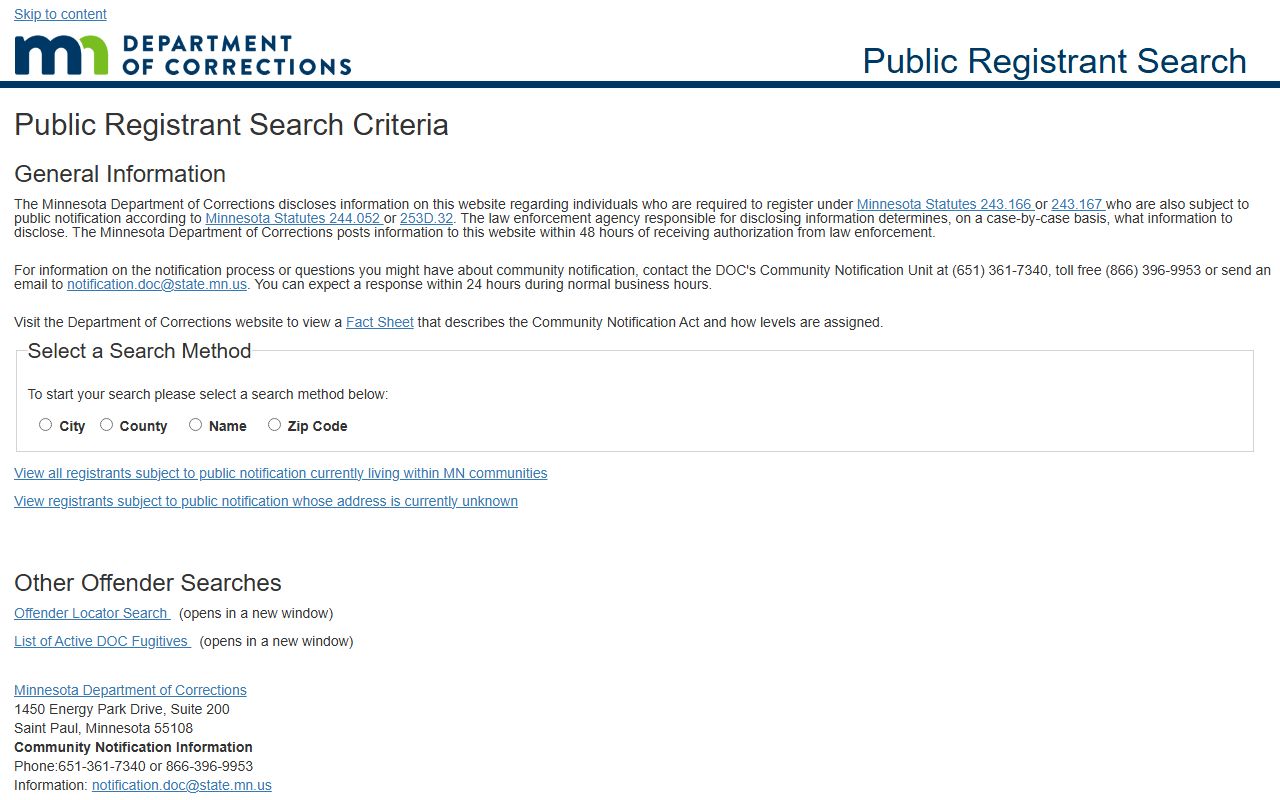
You can run a name search, limit results by county, or enter a zip code to see registered offenders nearby.
The DOC Community Notification page covers risk levels, the review process, and resources for communities dealing with a nearby offender release.
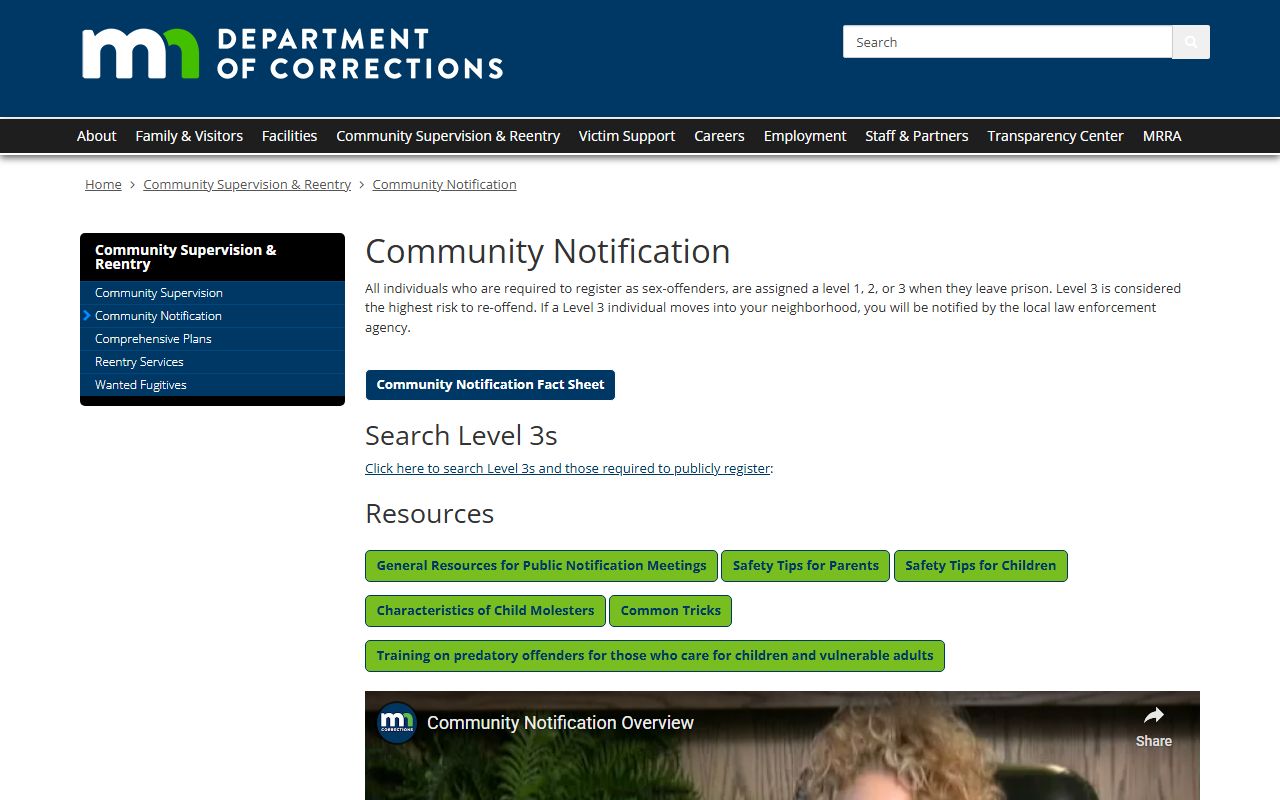
The page also provides fact sheets and safety materials you can download.
Note: The DOC public database shows Level 3 offenders only. Level 1 and Level 2 predatory offenders are not listed on the public website, though they remain registered in the BCA system.
How to Search Minnesota Predatory Offenders
The DOC Public Registrant Search gives you several ways to find Minnesota sex offenders. You do not need an account. You do not need to pay anything. Go to coms.doc.state.mn.us/publicregistrantsearch and pick your search method. Name searches work well when you know the person. Location-based searches are more useful when you want to see who is registered near a specific address or neighborhood.
Here is what you can search by:
- First name, last name, or both
- City name
- County
- Zip code
- Address with a set radius
Each result gives you a photo, physical description, and the offense the person was convicted of. The address shown is block-level, not the exact house number. That is by design. If you need to confirm an exact address, contact your local law enforcement agency or the DOC Community Notification Unit at (651) 361-7340. The toll-free number is (866) 396-9953. You can also email notification.doc@state.mn.us.
The BCA Predatory Offender Registry at por.state.mn.us handles the backend registration database. The public can access some information there. For questions about registration status or the compliance process, the BCA is at 1430 Maryland Ave E, St. Paul, MN 55106.
The BCA Predatory Offender Registry is where registration forms are processed and compliance is tracked for all Minnesota predatory offenders.
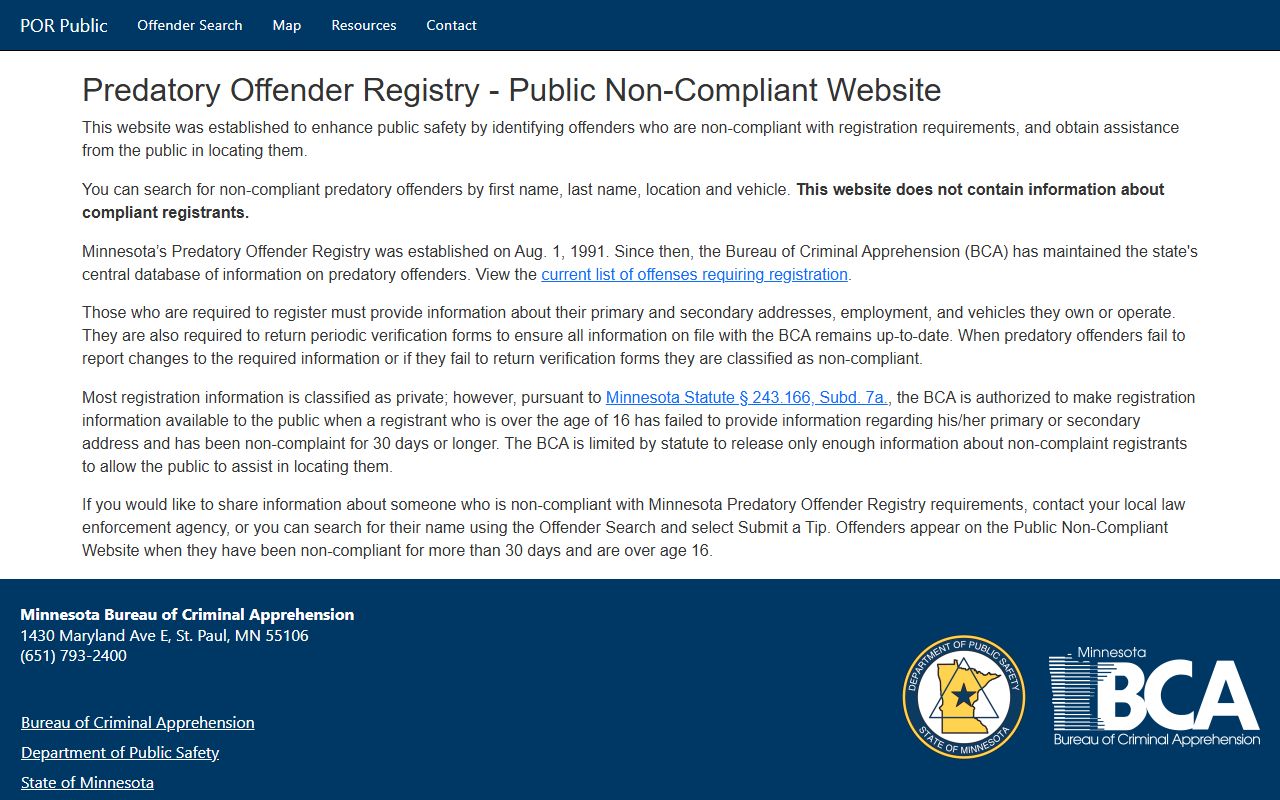
The BCA maintains the master list of registered offenders and handles non-compliance disclosures after 30 days.
The BCA Bureau of Criminal Apprehension oversees predatory offender registration statewide, including coordination with local law enforcement when offenders move between counties.
The BCA also handles DNA collection and maintains fingerprint records for all registered predatory offenders.
Minnesota Risk Level System for Sex Offenders
Minnesota assigns every predatory offender a risk level before they are released from confinement. The End-of-Confinement Review Committee does this work. The committee meets at least 90 days before release. It includes the facility head, a law enforcement officer, a treatment professional, a caseworker, and a victim services representative. They score the offender using the MnSOST-3 risk assessment scale. That score, combined with other factors, determines the risk level.
Level 1 means low risk. The offender's information stays with law enforcement. The public does not get notified. Victims and witnesses may get notice in some cases, but there is no community-wide disclosure. Level 1 offenders are not posted on the DOC public website. They are still registered in the BCA system and must follow all registration rules like any other predatory offender in Minnesota.
Level 2 means moderate risk. Schools, daycares, and groups that work with children or vulnerable adults get notified. Immediate neighbors may also be told in some situations. Level 2 sex offenders are not listed on the public website by default, though local law enforcement may decide to post them in certain cases. Organizations that are likely to come into contact with the offender receive fact sheets with photo and offense information.
Level 3 means high risk. This triggers the broadest public notification. Community meetings are often held. Flyers go out to residents within about three blocks of where the offender will live. Local media may get notified. The information goes up on the DOC public website, which is what most people see when they search Minnesota sex offenders online. Level 3 is what the public registry is built around. The DOC must update the website in a timely way when an offender's address changes.
Offenders assigned Level 2 or Level 3 can appeal. They have 14 days to request an administrative review. A hearing before an administrative law judge follows. The offender must show the committee's assessment was wrong. The burden of proof is on the offender. The attorney general's office defends the committee's determination.
The DOC Public Viewer lets you look up offenders currently under DOC supervision, including those in prison and those on supervised release in the community.
The Public Viewer shows custody status, facility location, and projected release dates for offenders under DOC jurisdiction.
Note: Risk levels can be reviewed and changed over time. Contact the DOC Community Notification Unit if you have questions about a specific offender's current level or notification status.
Minnesota Predatory Offender Registration Requirements
Under Minnesota Statute 243.166, certain people convicted of qualifying sex crimes must register as predatory offenders. This includes convictions for criminal sexual conduct in the first through fourth degrees, felony criminal sexual predatory conduct, kidnapping, and related offenses. Convictions under federal law or another state's law that match Minnesota's qualifying crimes also trigger registration. Civil commitment under Chapter 253D does as well.
When someone registers, they must give law enforcement a signed statement, fingerprints, a DNA sample, and a photo. The photo gets updated every year or when the person's appearance changes significantly. Beyond that, offenders must report a long list of current information. That list includes their primary address, all secondary addresses, any Minnesota property they own or lease, where they work, where they go to school, vehicle details including license plate and color, and all phone numbers. Any change to that information must be reported within five days.
Offenders without a fixed address face extra requirements. They must register within 24 hours of losing their primary address. After that, they report in person to law enforcement every week between 9 a.m. and 5 p.m. They must describe their location with as much detail as they can. This rule keeps homeless predatory offenders tracked and visible to law enforcement even without a fixed address.
The standard registration period is 10 years, or until the offender's period of supervised release expires, whichever is later. Registration can extend further. Each failure to register adds five years to the period. Repeat offenders, those with aggravated offenses, or those civilly committed must register for life. Registration time does not count while someone is incarcerated for a new offense.
Minnesota Statute 243.166 is the core law for predatory offender registration in the state.
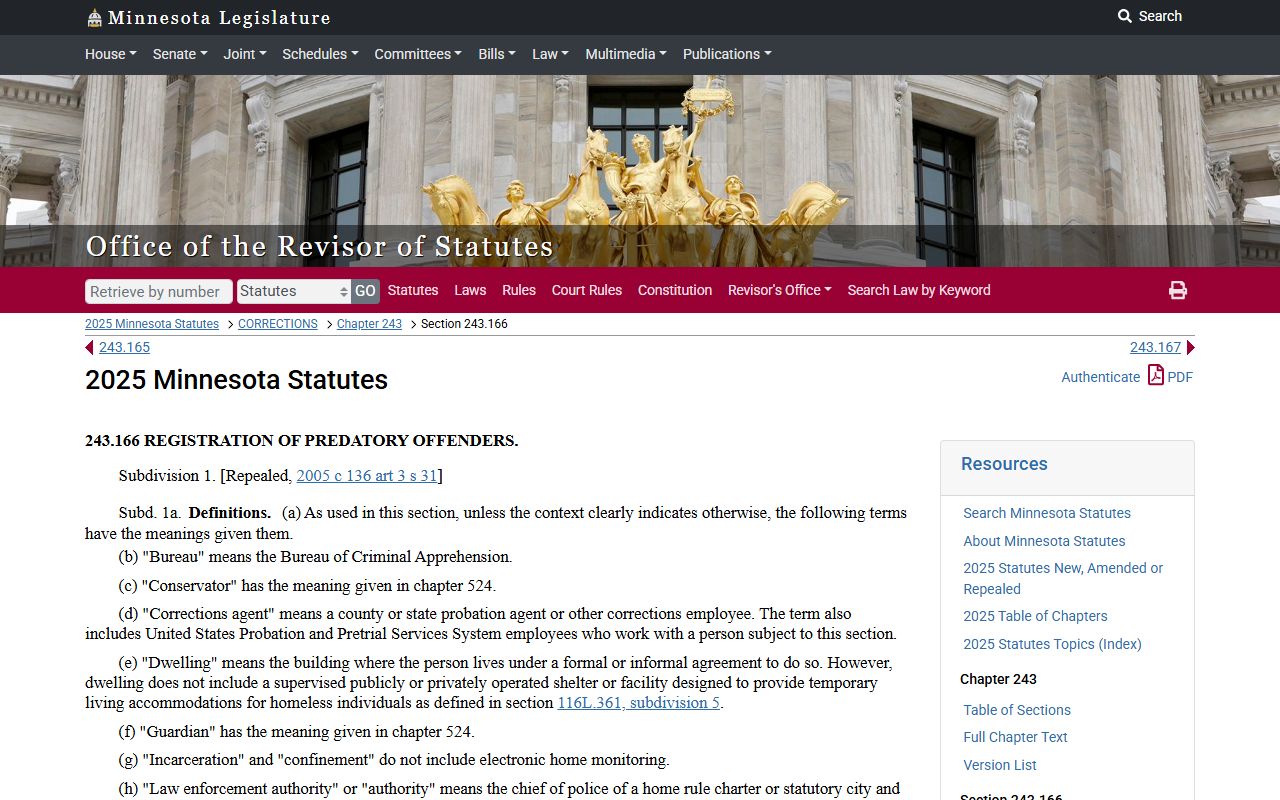
The statute spells out who must register, what information they must provide, and the criminal penalties for failing to comply.
Minnesota Statutes Governing Sex Offenders
Two statutes drive most of Minnesota's predatory offender system. Minn. Stat. 243.166 covers registration. Minn. Stat. 244.052 covers community notification. These two laws work together to keep registration active and make sure communities get appropriate notice when a high-risk offender moves nearby. Minnesota uses the term "predatory offender" in law rather than "sex offender," though both terms refer to the same registered population.
Failing to register is a serious crime. Under Statute 243.166, a knowing violation is a felony. First-time failures to register carry a mandatory minimum sentence of one year and one day. A second or later offense raises that minimum to two years. The maximum penalty is five years in prison and a $10,000 fine. Offenders serving time for failure to register are not eligible for probation or early release until they serve the full term.
Statute 244.052 is the Community Notification Act. It sets the rules for how and when law enforcement discloses information about predatory offenders to the public. It also establishes the End-of-Confinement Review Committee process. The law requires Level 3 notifications to reach community members likely to encounter the offender. It instructs the DOC to maintain a public website with Level 3 information. Law enforcement must make a good faith effort to complete notification within 14 days of getting a confirmed address.
Minnesota's Government Data Practices Act, Chapter 13, controls what information is public and what is private. Most predatory offender registration data is private. Only law enforcement and corrections agencies have full access. What goes on the public website is a defined subset: name, date of birth, photo, physical description, offense information, risk level, and general location. Exact addresses, employment details, vehicle info, and phone numbers are private and stay within the law enforcement system.
Minnesota Statute 244.052 lays out the community notification framework and the risk assessment process used before every offender release.
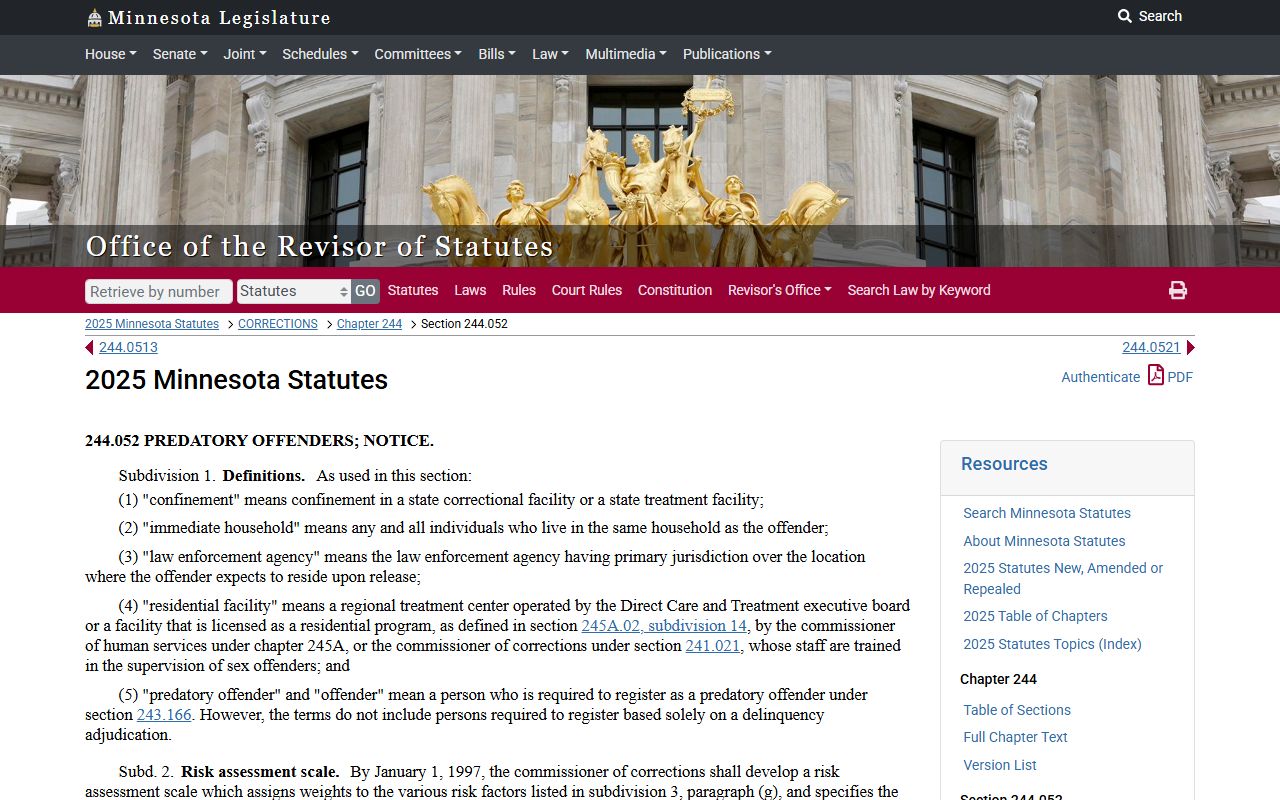
This statute defines the three risk levels, the review committee structure, and what law enforcement must disclose at each level.
Additional Resources for Minnesota Sex Offender Information
The Dru Sjodin National Sex Offender Public Website (NSOPW) connects public registries from all 50 states, territories, and tribal nations in one search. It is named after Dru Sjodin, a 22-year-old University of North Dakota student from Minneapolis who was murdered by a registered sex offender in 2003. Her case helped push Congress to fund and build this federal database. You can search by name or by location and pull results from multiple states at once. A free mobile app is available for iOS and Android.
VINE is an automated victim notification system. You can register at vinelink.com or call 1-877-664-8463. VINE monitors custody status at county jails and DOC facilities. It sends alerts when someone is released, transferred, or has a custody change. It is free to use. You can get alerts by phone, email, or text. Note that VINE tracks jail and prison custody, not community registration status. It does not send alerts when a registered sex offender moves to a new address after release.
The Minnesota Judicial Branch website at mncourts.gov gives you access to court case records. You can search criminal case files, look up conviction information, and find hearing records from all 87 counties. Court forms are available through the forms portal at mncourts.gov/GetForms.aspx. The Minnesota Sex Offender Program at mn.gov/dhs handles civil commitment cases. MSOP operates two facilities: Moose Lake at 1111 Highway 73 and a unit at the Minnesota Security Hospital in St. Peter. Over 720 people are currently in the program.
The National Sex Offender Public Website is named for Dru Sjodin and links all state and tribal sex offender registries in one federal search tool.
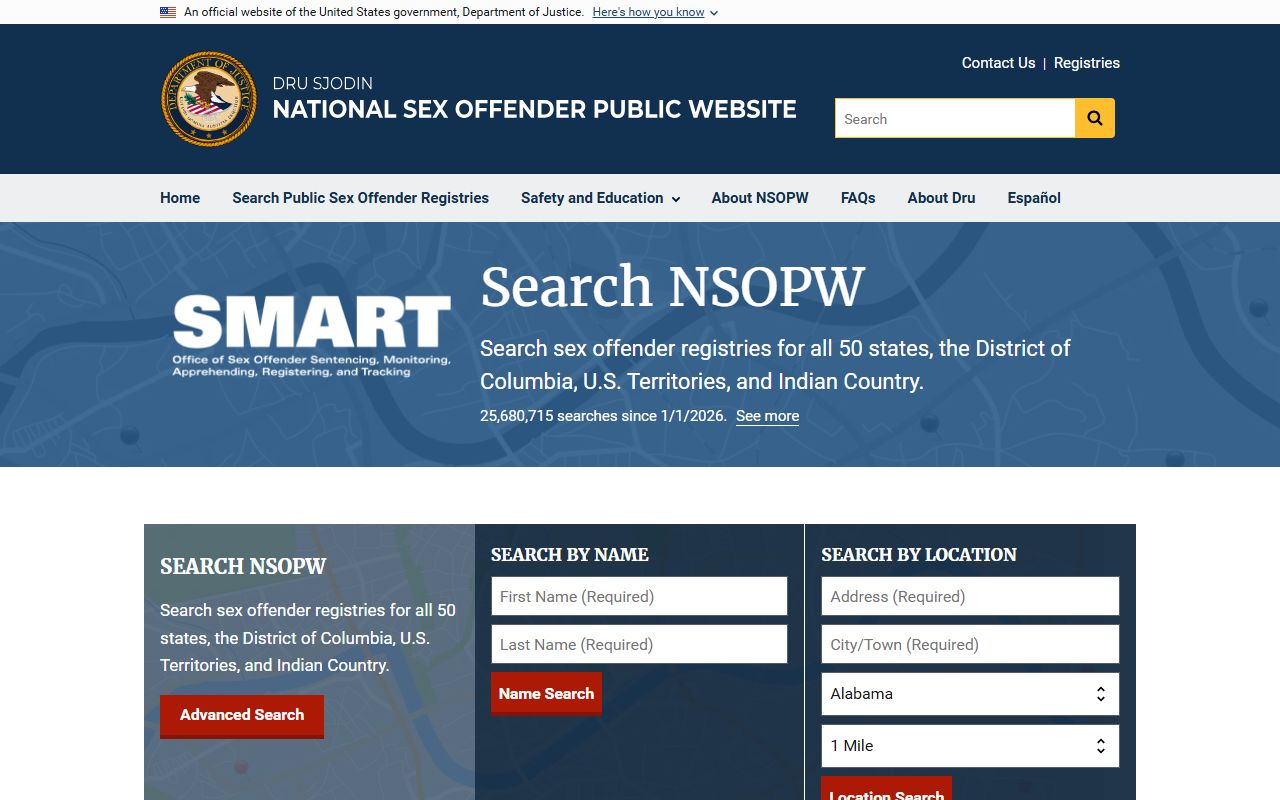
NSOPW pulls results directly from each state's registry, so Minnesota results reflect what the DOC has posted publicly.
The VINE notification system lets victims and concerned individuals register for automatic alerts about custody changes for specific offenders.
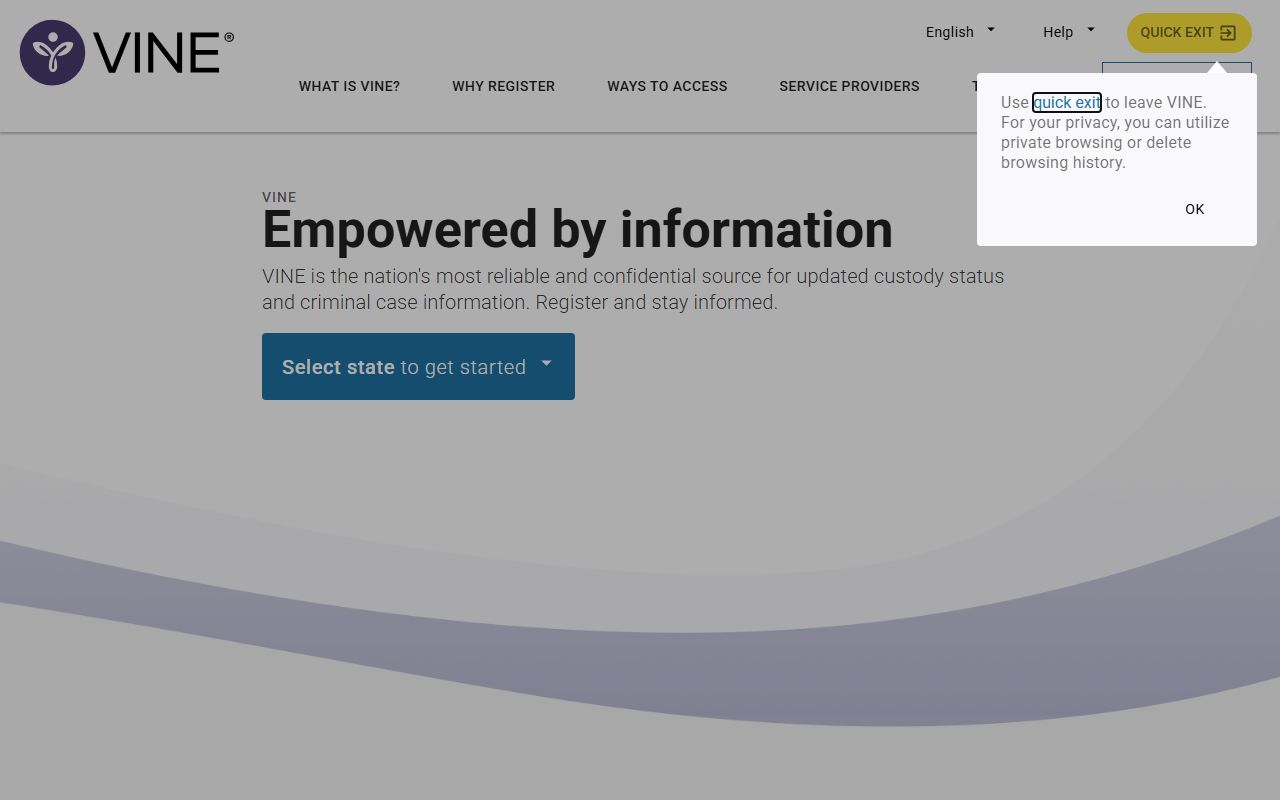
VINE covers county jails and DOC facilities across Minnesota and sends alerts through phone, text, or email at no charge.
The Minnesota Court Records Online system provides access to criminal case information from all 87 counties, including conviction records related to sex offense cases.
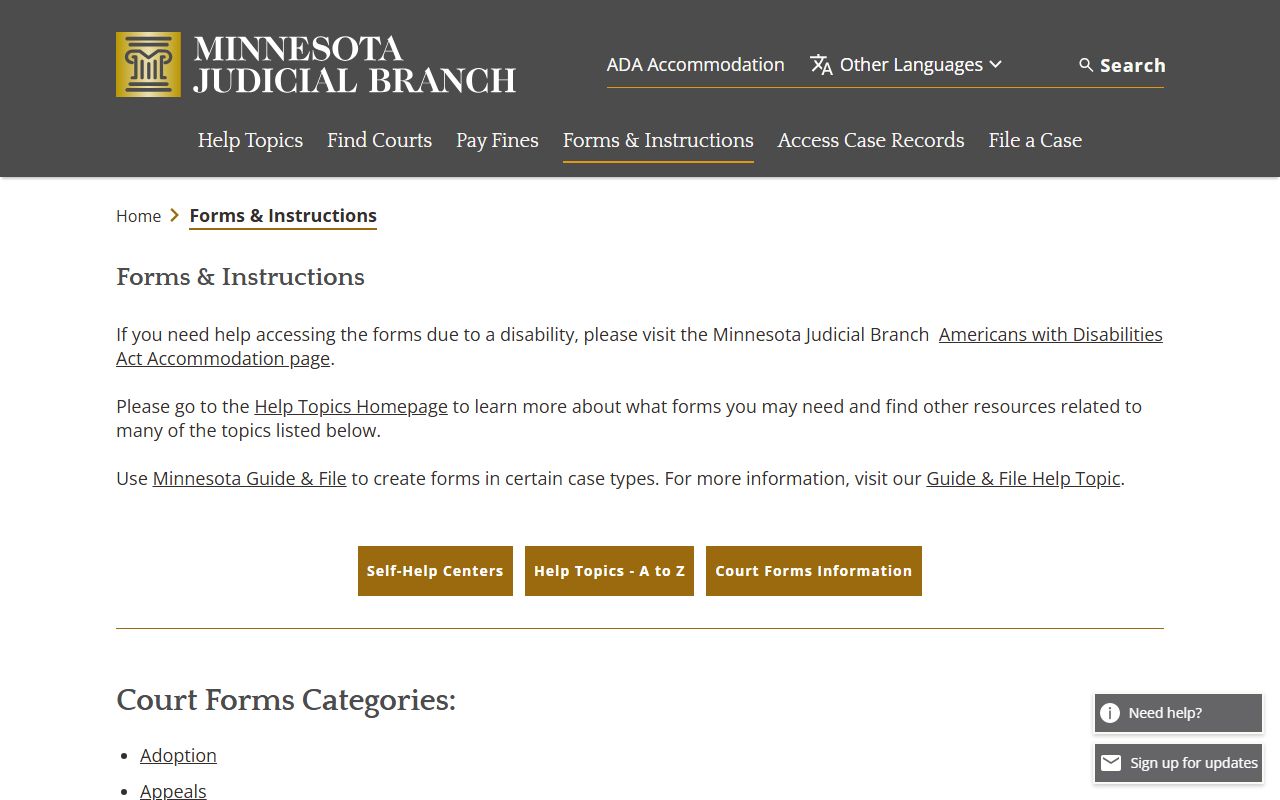
Court records include case status, party names, charges, and hearing dates for criminal matters across the state.
The Minnesota Judicial Branch oversees the court system where criminal sexual conduct cases are prosecuted and where civil commitment petitions for MSOP are heard.
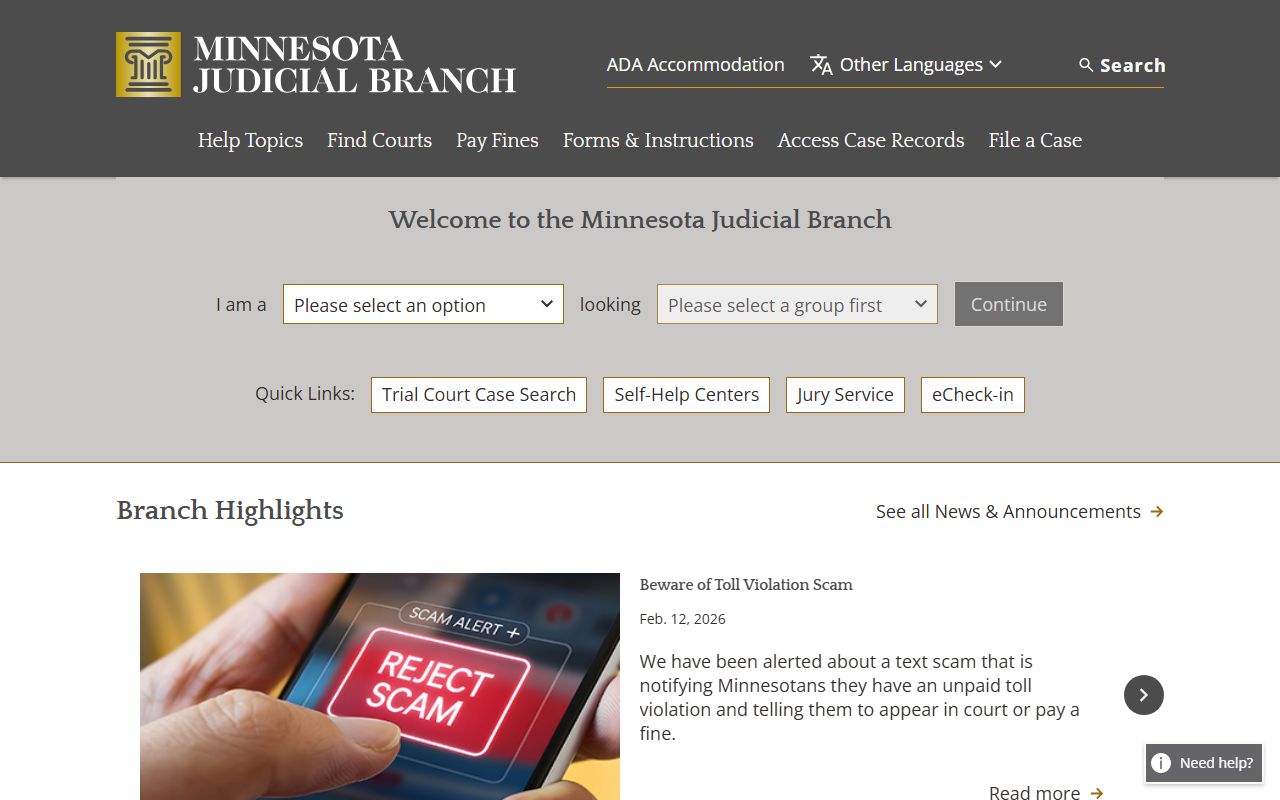
The Judicial Branch site also links to self-help resources and the statewide court case search system.
The Hennepin County Attorney's Office handles sex offense prosecutions in Minnesota's most populous county and provides victim resources for those going through the criminal justice process.
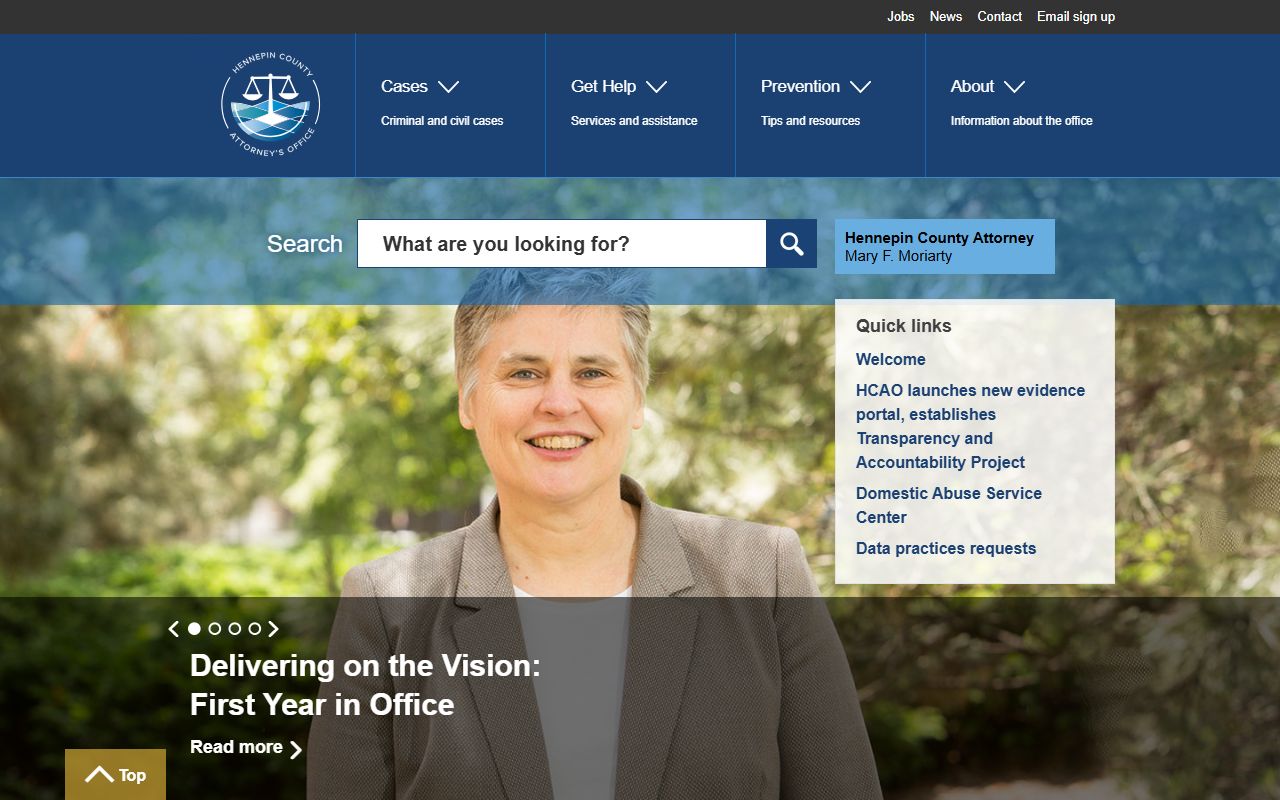
County attorneys across Minnesota play a key role in the civil commitment process, filing MSOP petitions for high-risk offenders completing prison sentences.
Note: For victim assistance, the DOC Victim Assistance line is 1-800-657-3830 and the email is victimassistance.doc@state.mn.us. Response times are typically within one business day.
Browse Minnesota Sex Offenders by Location
Each of Minnesota's 87 counties has its own local law enforcement that participates in predatory offender notification. Select a county below to find local registry resources, courthouse information, and county-specific sex offender data.
View All 87 Minnesota Counties
Search Sex Offenders in Major Minnesota Cities
Minnesota's largest cities fall within county jurisdictions for predatory offender registration. Select a city below to find sex offender registry resources, local law enforcement contacts, and nearby county court information.